
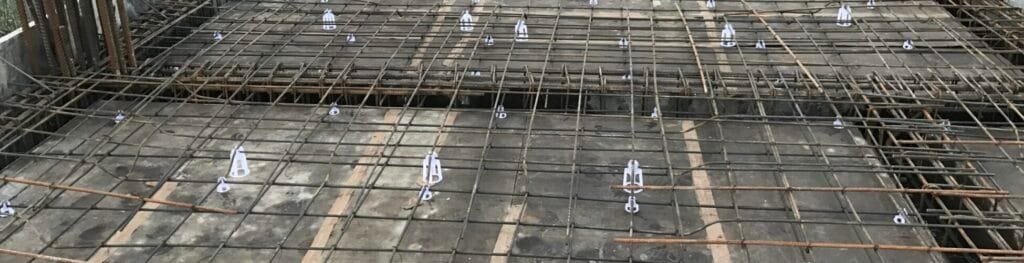
What is a rebar chair?
A rebar chair is a support used to hold steel above the layer below it. In slabs, it is used where top steel or an upper steel mat has to stay at a fixed level.
A cover block controls concrete cover. A chair supports top steel. The same slab can therefore need both cover blocks and rebar chairs.
Used mainly to establish the specified concrete cover at bottom or side reinforcement.
Used to support top steel at the required level.
Why top steel needs support
The structural drawing shows where top steel is required and the level at which it should remain. Chairs help keep that level while steel is fixed, services are installed and concrete is placed.
Without enough support, top steel can sag or get pushed down when people move over the reinforcement or during concreting. It should be properly supported before casting instead of being lifted by workers while concrete is being placed.
Why top steel position matters
Top steel is not placed at an approximate height. In support zones, cantilevers and other top-tension regions, its position is part of the structural design.
If top steel moves downward, the effective depth in that region can reduce. That changes the internal lever arm assumed in design and can reduce flexural performance. Depending on the member and amount of movement, stiffness, cracking and deflection can also be affected.
The structural design assumes the top steel is at a defined position.
Foot traffic, weak supports or movement during concreting can push the top steel downward.
In top-tension regions, dropping the steel can reduce the effective structural depth and lever arm.
Flexural capacity, stiffness, cracking and deflection may be affected. In applicable slab-column zones, local behaviour including punching-shear performance also needs engineer consideration.
Section 12.2 requires reinforcement to be placed and maintained in the position shown on the drawings. Section 12.3.2 calls for spacers, chairs or other supports as necessary to maintain the required reinforcement position and nominal cover; support spacing may need to be closer than 1 m where site conditions require it.
For project approval, use the structural drawing, project specification and relevant product documentation for the chair being proposed.
Read the practical IS 456 guide →Where top steel is used
On site, “top steel” can mean different things. The drawing decides which type is present and where it is required.
Often called negative steel. These bars are placed over or near supports in continuous slabs.
A second layer of steel above the bottom steel, over all or part of the slab.
Top steel provided in cantilevers, especially near the support.
Bars bent upward as part of the steel detail. They are not chairs, but chairs may be used to support them at the required level.
Extra top bars may be provided around columns, openings, supports or other local areas.
Some slabs have top steel over almost the full area. These need many more chairs than slabs with top steel only near supports.
Where chairs are needed
Do not spread chairs over the full slab unless top steel is present there. In many slabs, top or negative steel is mainly near supports. The drawing may show it extending for part of the span, such as L/4 or L/3.
L/4 and L/3 are not universal rules. They simply explain why the total chair quantity can be much lower than a 3 ft grid over the full slab area.
as shown on drawing
top steel only if specified
as shown on drawing
The 3 ft spacing applies only where chairs are needed. The 50 pcs / 1,000 sq ft figure is a whole-slab planning estimate for common layouts. A full top mat, flexible bars, concentrated site traffic or dense steel can require a different support arrangement.
What a chair must do
A chair needs the right height, enough strength and good stability. It should stay in place and support the steel without unacceptable permanent deformation.
The chair must hold top steel at the required level for the actual bar arrangement.
The chair should remain upright and properly seated under normal site handling and reinforcement loads.
The chair must support the intended reinforcement without unacceptable permanent deformation.
The chair and supported bars should resist unwanted movement during steel fixing and concreting.
Supports should be close enough for the reinforcement stiffness and construction conditions. One universal spacing is not correct for every case.
Heavy steel mats, thick rafts and unusual reinforcement may need a different support system.
BS 7973-1 covers both spacers and chairs, but their performance tests and classifications are not identical. The often-quoted approximately 3 kN “heavy spacer” point-load level belongs to spacer classification; it should not be applied directly to rebar chairs. For chairs, judge the actual support product by the relevant chair test requirements, permanent deformation, stability, fixity and the intended site loading.
Read BS 7973: Spacers & Chairs Explained →Chair height and top cover
The final level of top steel depends on slab thickness, bottom cover, bar sizes, the gap between steel layers and the required top cover.
So a 75 mm or 100 mm chair describes the support height. It does not mean 75 mm or 100 mm concrete cover.
CL-75 and CL-100
CL-75 and CL-100 are platform-type rebar chairs placed on shuttering to support top steel at a fixed manufactured height. Their geometry is intended to locate the crossing of bars and help keep the steel seated in position.
CROSSLOCK commonly uses CL-75 for a 5 inch slab arrangement and CL-100 for a 6 inch slab arrangement. Final selection must still match the actual bar sizes, steel layers, top cover and structural drawing.
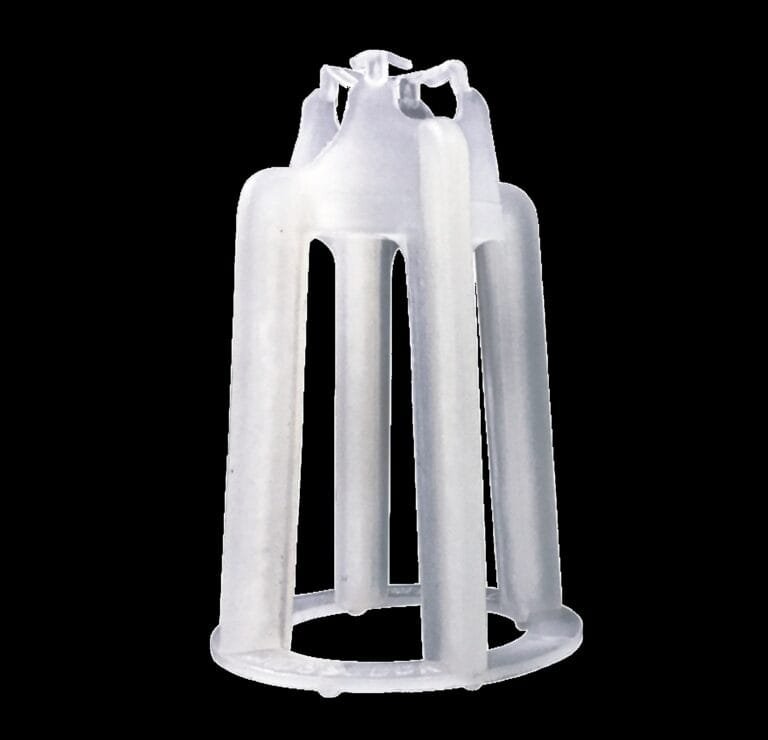
CL-75 – Rebar Chair for Top Reinforcement (Pack of 50 Pieces)
- Primary use
- Not available in product data
- Support height
- 75 mm
- Compatible main bar
- Ask CROSSLOCK
- Slab reference
- Approximately 5 inch slab
- Pieces / Packet
- 50
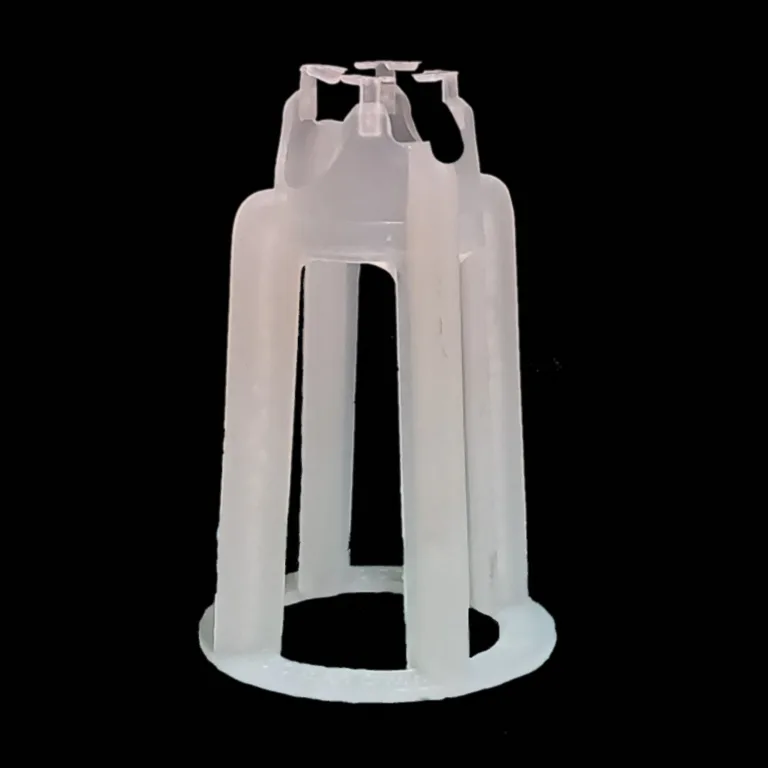
CL-100 – Rebar Chair for Top Reinforcement (Pack of 30 Pieces)
- Primary use
- Not available in product data
- Support height
- 100 mm
- Compatible main bar
- Ask CROSSLOCK
- Slab reference
- Approximately 6 inch slab
- Pieces / Packet
- 30
If a product detail is not shown, confirm it with CROSSLOCK before ordering or specifying the chair.
How to Place Rebar Chairs
Chair installation is simple. The important points are the right support height, the right top-steel zone and proper seating of the bars before concrete is placed.
- Choose the chair from the drawing and steel arrangement.Match the support height to the slab and actual bar layers. Do not select CL-75 or CL-100 from slab thickness alone.
- Place the chair below the top-steel crossing.Seat the crossing properly on the chair and keep the top bars tied so they cannot easily move. Repeat only through the zones where top steel needs support, at the planned spacing.
- Check before concreting.Make sure chairs are upright and stable, the bars are seated and tied, and the top-steel level is uniform. Replace any damaged or badly seated support before casting.
Chair support options
Site-made steel chairs are common and can be made in many heights. Heavy top steel may use engineered standees. Manufactured chairs are another option where their height, strength and steel arrangement suit the job.
CROSSLOCK should be used where its height, performance and geometry suit the slab. It is not a universal replacement for every steel-chair arrangement.
Calculate chair quantity
The Product Selector & Quantity Planner can estimate chair quantity when Top Steel is selected. Use it for planning instead of forcing every quantity rule into this education page. The structural drawing still decides where top steel is required and at what level.
Codes & Technical References
This page is educational guidance for product selection and site planning. Project drawings, structural specifications and the engineer's instructions take priority.
- BS 7973-1:2001 — product performance requirements for spacers and chairs
- BS 7973-2:2001 — fixing and application of spacers and chairs
- CRSI — Reinforcing Bar Placing and bar supports
- CRSI — Reinforced Concrete Terminology: high chairs and support bars
- ACI / Concrete International — Reinforcing Bar Layout for Two-Way Slabs
- MPLAST INDUSTRIES — CROSSLOCK brochure and product data for CL-75 and CL-100.
Common questions
Is a rebar chair the same as a cover block?
No. A cover block is primarily used to establish concrete cover between reinforcement and the concrete face. A rebar chair primarily supports upper reinforcement at the required height.
Do chairs have to be placed across the entire slab?
Not necessarily. Put chairs where top steel needs support. If top steel is only near supports, chairs can also be limited to those zones. A full top mat needs more chairs.
Why does the brochure show both 3 ft spacing and about 50 chairs per 1,000 sq ft?
Use the 3 ft guideline within the top-steel zone. The 50 pcs / 1,000 sq ft figure is a whole-slab planning thumb rule for common layouts where top steel covers only part of the slab.
Is L/4 or L/3 always the correct top-steel length?
No. Those are common detailing proportions seen on some drawings, but they are not a universal rule. The structural drawing decides the actual bar length and location.
Can I choose CL-75 only because my slab is 5 inches thick?
Slab thickness is a useful first check. CL-75 is commonly used with a 5 inch slab arrangement, but final selection must also match the actual steel layers, bar sizes, top cover and drawing.
Can CROSSLOCK replace every steel chair?
No product should be treated as a universal substitute. Heavy reinforcement mats, thick foundations and unusual structural arrangements can require engineered standees or another support system. Use CROSSLOCK where its height, performance and geometry are suitable.
Should reinforcement be lifted during concrete placement?
Top steel should be supported at the required level before concrete is placed. Check the supports before casting instead of relying on workers to lift the bars during concreting.
Does the BS 7973 heavy-spacer 3 kN figure apply to rebar chairs?
No. BS 7973-1 treats spacer and chair performance separately. The approximately 3 kN heavy classification is a spacer point-load classification and should not be copied directly onto a chair. Chair suitability needs to be checked using the relevant chair performance requirements and the intended site loading.
Ask CROSSLOCK about your slab
Send the slab thickness, top-steel arrangement, bar sizes and the relevant drawing detail. We can help you identify whether CL-75, CL-100 or another support method is the sensible next check.